

Pro-life leader and self-proclaimed “Christian” Kristan Hawkins denied reports about families in Morgan County, Georgia, being poisoned by contaminated drinking water caused by a Meta data center, and pushed her false claim about abortion pills contaminating water and killing women, which has been debunked by multiple sources.
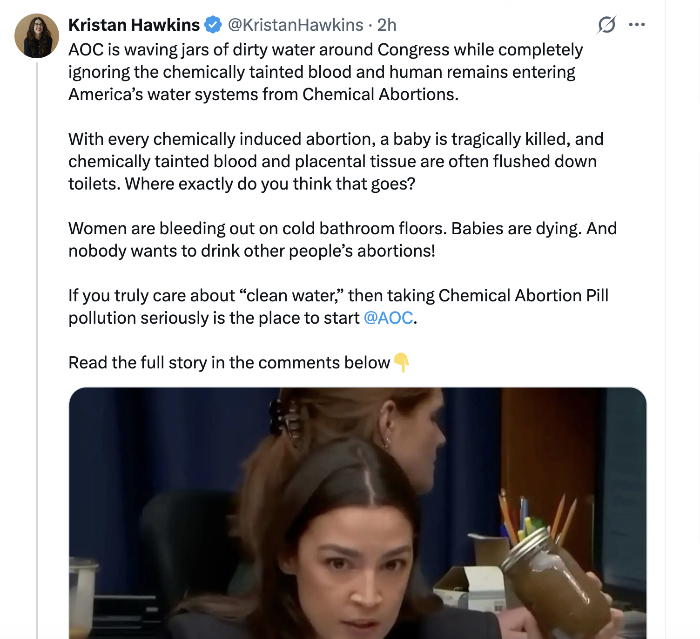
Hawkins tried prove her denial by linking to an op-ed — not a news report — by right winger Rich Lowry who defended data centers, but actually did admit the families’ water wells were contaminated by Meta, which contradicted Hawkins.

Lowry wrote in the California Post:
It stands to reason that the construction of the data center disturbed the private wells of these homes (the problems started when Meta broke ground), but that could happen with any construction project.
Hawkins’ claim about chemical abortions (abortion pills) being dangerous to drinking water has been debunked, notes MedPage Today:
Environmental scientists say there is no credible evidence that mifepristone (Mifeprex) or fetal tissue is contaminating U.S. water supplies at levels that would harm humans, animals, or the environment, despite claims from advocacy groups linking at-home abortions to water pollution…
“Most scientists would agree that there is no evidence that mifepristone pollution harms people, animals, or ecosystems,” Jack Vanden Heuvel, PhD, a professor of molecular toxicology at Pennsylvania State University in State College, told MedPage Today.
Tracey Woodruff, PhD, MPH, of the University of California San Francisco, who has studied estrogenic compounds and birth control hormones in water, also dismissed the claims. She called attempts to frame mifepristone contamination under the National Environmental Policy Act as “a very clever use of legal language.”
“But I don’t think it holds a lot of water,” she told MedPage Today.
Mifepristone tends to bind to solid waste and is effectively removed by most modern wastewater treatment plants, Vanden Heuvel said, adding that advanced processes such as ozonation can further degrade steroidal drugs and make the likelihood of meaningful exposure through drinking water extremely low. The FDA’s original 1996 assessment of mifepristone concluded the drug has no significant environmental impact.
Hawkins and her anti-abortion group Students for Life were also debunked by POLITICO:
Environmental scientists and engineers told PolitiFact there is no evidence that mifepristone has harmed the environment or people via wastewater.
“There is absolutely no evidence that this is an environmental issue,” said Nathan Donley, the environmental health science director for the Center for Biological Diversity. “Pharmaceutical waste can be a big issue when we’re talking about widely used drugs, but to somehow point to mifepristone as a bad actor here is completely disingenuous.”
Students for Life cited one scientific paper in its petition that identified at least three active metabolites, or byproducts, in mifepristone that can remain active after passing through a person’s system. But this is typical of many pharmaceuticals. It is not a sign that the drug is harmful.
(Sources: Kristan Hawkins/X, California Post, MedPage Today, POLITICO)